På mødet, hvor kandidaterne indledningsvis fik to minutter hver til at præsentere deres generelle erhvervspolitiske synspunkt, gav Poul Gundersen en kort præsentation af sig selv og Schiller Instituttets Venner. Dernæst en ultrakort faktuel introduktion til Silkevejen samt Helga Zepp-LaRouches rolle. Poul Gundersen citerede derefter et afsnit fra minister Karen Ellemans tale på Bælt og Vej Forum i Beijing tidligere i år, og orienterede kort om præsident Trumps nært forestående rejse til Asien og planlagte møde med præsident Xi Jinping i Kina.
Poul Gundersen stillede ved udløbet af den indledende taletid det retoriske spørgsmål : “Og hvad har så dette med Randers at gøre?”, og opfordrede publikum til eventuelt at tage spørgsmålet op senere.
En person i salen vendte tilbage til spørgsmålet i diskussionsrunden, og Poul Gundersen talte om forbedring af jernbaneforbindelserne omkring Randers, og på længere sigt forbindelse til København/Malmø området via en mulig Kattegatforbindelse. Han nævnte muligheden for, at man som erhvervsdrivende i Randers kunne tage spørgsmålet op i regionalt regi for derved at påvirke regionalrådets til at skrive Silkevejen ind i Vækst og Udviklingsplan 2015-2025.
Mod slutningen af mødet blev kandidaterne spurgt om, hvad de ville gøre for at tiltrække børnefamilier til Randers, og Poul Gundersen fremførte afslutningsvis det andet vigtige punkt på Schiller Instituttets valgprogram, nemlig tilbud om gratis klassisk musikundervisning af alle børn, og understregede vigtigheden af at udvikle de menneskelige ressourcer og få en fremtidig arbejdsstyrke, der er i stand til at tænke og få gode ideer.
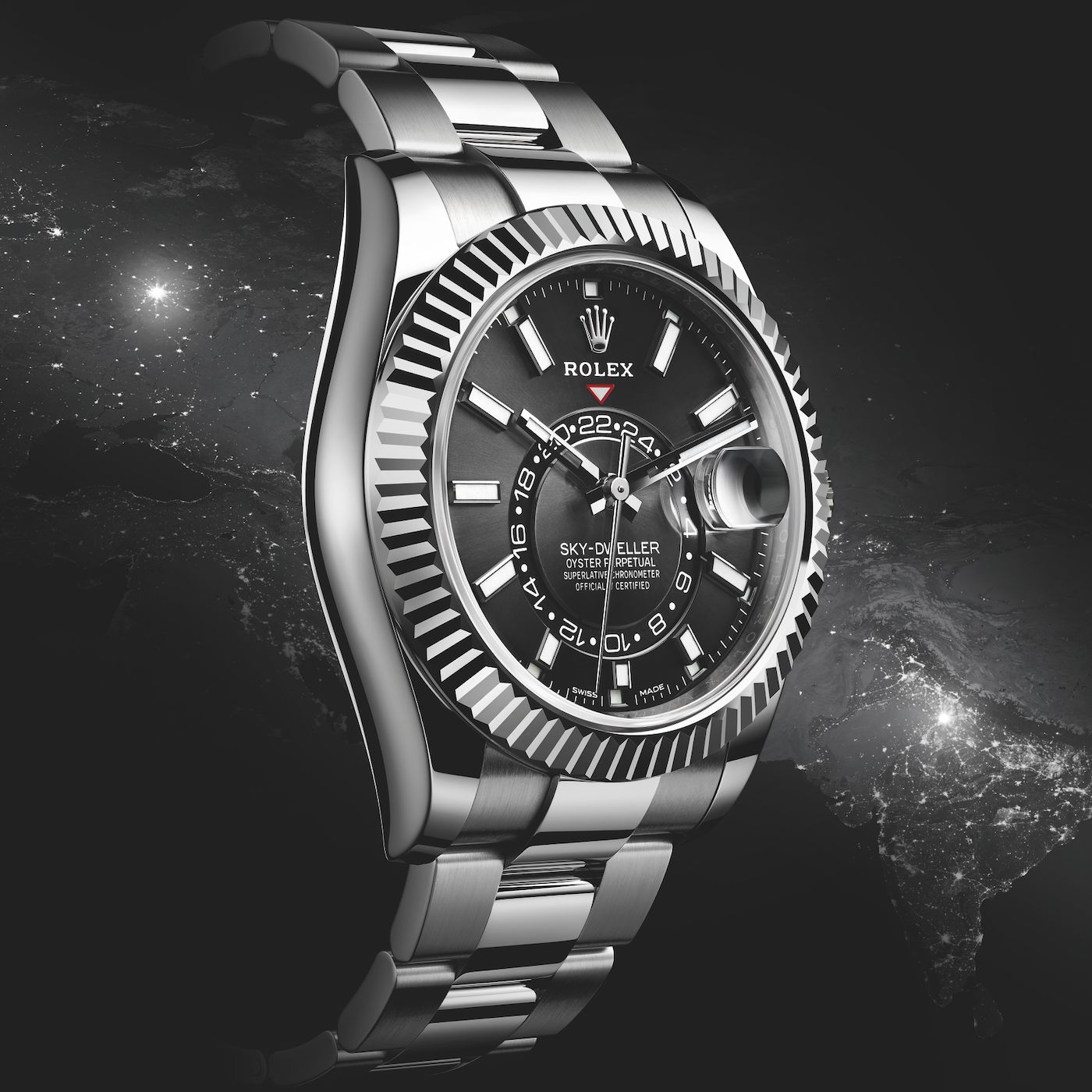
Your first luxury-level watch purchase should be exciting and meaningful. But, we get it — it can also be a daunting proposition for newbies. Everyone has different needs, tastes, means and understanding of “luxury,” so no one can say what’s the right watch for you. A little guidance, however, can help you ask the right questions and make an informed choice for yourself.
First, why do you want a luxury watch?
There are different reasons to want a “nice watch.” Identifying your situation and motivation will help you focus your search right away. Try out this rolex replica.
Do you simply want an elegant everyday watch that’s built to last? The good news is you’ve got a lot of great options, and you’re not limited to prestigious brand names and hefty price tags. The bad news is that you still haven’t narrowed down your choices much, as many watches offer this level of quality. You’ll want to look at other factors like price, style and features, and consider if one of the below situations also applies to you.
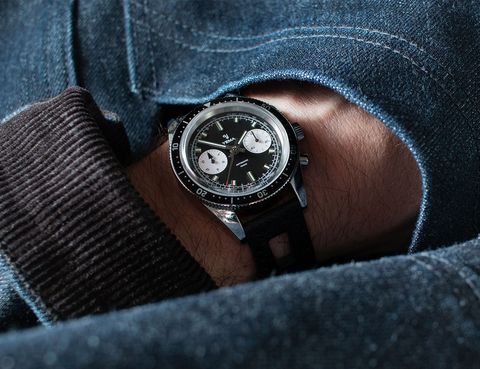
Do you want a watch to enhance your personal style? Visual elements and brand names might factor more heavily in your decision — but you’ll want to consider the aesthetic basics such as dress or sport and modern or retro. Sport watches are popular and offer a range of styles originating in specific uses, like diving, flying, racing and the military. If you can identify a genre you’re particularly interested in, you’re well on your way.
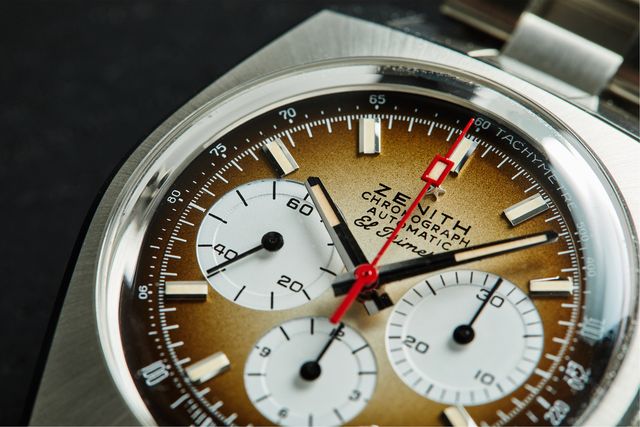
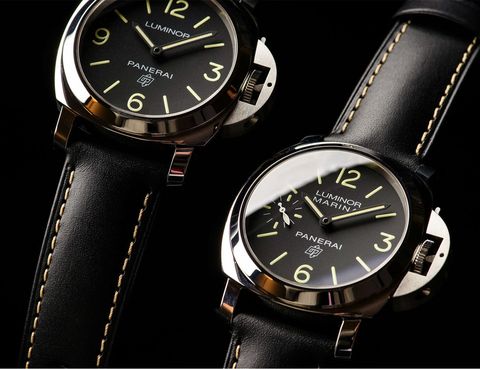
Do you need a watch to enhance your professional presentation? This is a common reason for people to get their first luxury watch: Some people feel a good watch can help them be taken more seriously by bosses or even impress potential clients. For these purposes, recognizable brands and models are safe and will serve you well — think names like Rolex, Panerai, Omega, IWC and Zenith. These are all brands whose pricing starts firmly in the mid to upper luxury range, but sometimes a simple and solid mechanical watch can be a great option for those on a tighter budget, as well as express one’s own taste and individuality.
Henry Phillips
Will your watch serve as a status symbol? This is an extension of the previous consideration: You’re doing well financially, and want to make it known. (Like, really known.) Sure, this can be accomplished simply with bling, like gold and diamonds, but sometimes just the name on an otherwise simple-looking watch does the job — think Rolex, Patek Philippe and Audemars Piguet. Watchmakers also signal prestige with complicated features such as skeletonization, avant-garde designs and tourbillons.
Are you interested in a luxury watch simply for experiencing its quality, engineering, details and history? You’re well on your way to being a #watchnerd, and even if you get a watch for other reasons, you might even come to appreciate it in this way. This is a great reason to want a watch, but because it’s what most luxury watches would claim to offer, you’ll want to narrow down your choices further and look to other factors discussed below.
What makes a “luxury watch?” And what qualities should you expect for your budget?
Budget is the basic starting place for any watch purchase. All watches are more or less luxuries today since they’re not necessary in modern life. For some people, $100 sounds like a lot to spend on something they don’t need, while others might feel that “luxury” begins at well into the thousands of dollars.
Thanks to the combination of improving production technology, the internet and globalization, features once out of reach for many have become more accessible than ever. With small microbrands leading the way and bigger brands responding with more focus on entry-level value, you can now get watches with elements like sapphire crystal, ceramic bezels, Swiss automatic movements and refined details for a just few hundred bucks — these are luxury features, and why we’ll begin talking about “luxury watches” at $500.
In order to identify the types of features you can expect at different price levels, we’ll broadly consider watches broken into entry-level, mid-range and high-end. These are imperfect categories that will in actuality bleed into one another — and there will always be exceptions — but the following generalizations are meant to help guide first-time buyers in what to look for.
Zen Love
What factors like style, size and technology should you consider?
Style. Watches can fall into many categories and genres, most broadly broken into dress and sport. Types of watches can be based on traditional purposes (dive watches, pilot watches, field watches, etc.), more vague designations (tactical watches, minimalist watches, etc.) or functionality (chronographs, GMTs, even alarm watches, etc.). There’s a lot to explore, but it helps to be aware of the purpose behind a watch design or features and the range of options available.
Size. The right watch size largely depends on the combination of your wrist size and how bold a look you prefer. Watch sizes are traditionally measured horizontally in millimeters and exclude the crown. However, other factors affect how big the watch will look and feel. They include the case thickness, its length lug-t0-lug as well as even its color and the size of the dial. Even the climate where you live (short-sleeve weather is better for bigger watches) and the type of clothing you normally wear is relevant. It’s recommended that you try on a watch before buying whenever possible, rather than relying on measurements alone to determine its fit. In addition to looking down at it on your wrist, also see how it fits in a mirror.
Buying a Rolex watch at retail has always been somewhat of an event. Back in the good old days, it usually meant that you were celebrating something (even if you were just celebrating yourself). However, buying a Rolex at retail is now considered an occasion simply because it means that you were lucky enough to get a call from your authorized dealer telling you that the wait is finally over and that you can finally purchase the watch that you want.
People often talk about the dreaded “waitlist” in regards to Rolex watches and their retail availability, but there are a lot of misconceptions about how allocation is actually determined. While it is certainly true that global demand far exceeds supply, buying a Rolex at retail isn’t actually completely impossible – assuming that you are a genuine enthusiast who is interested in owning the watch, rather than someone who is simply interested in flipping it for a quick profit. Nothing in life is certain (especially when it comes to the retail availability of luxury watches), but here’s how to buy a Rolex at retail.
LUXURY AND AVAILABILITY
Before we actually get into how to go about buying a Rolex at retail, it might be worth taking a brief moment to discuss the concept of luxury as it pertains to retail availability. I definitely understand where some people are coming from when they say that a luxury purchase should not involve having to cultivate a relationship with your dealer or spend any amount of time on a waiting list. These are the most popular fake rolex.
To a certain degree, I do agree with that sentiment. A luxury purchase is more than just receiving a premium item in exchange for a decent chunk of change. The process itself should feel luxurious, and (at least in my opinion) a “luxury” experience doesn’t involve being told that you need to wait, nor does it involve buying other items so that you can create a purchase history with your retailer.
However, regardless of our personal sentiments about what constitutes a luxury experience, there is an overwhelming global demand for Rolex watches, and not everyone who wants to buy one is going to be able to get one in a timely manner. I think everyone (including the staff members who work at your local retailer or boutique) would prefer if anyone who wanted a Rolex could simply purchase the watch of their choice (after all, selling watches is how they make money). However, the simple fact that global demand far exceeds supply means that there’s a shortage at a retail level, and whether you like it or not, you’re going to need some relationship with your authorized retailer if you want to buy a brand-new Rolex.
THERE ISN’T ACTUALLY A LIST
Now, I hate to be the one to break this to you, but there isn’t actually a Rolex waiting list. When people say they are on the “waitlist” or that they are waiting for their name to come up at their dealer, they really just mean that they are still waiting for their retailer to be able to allocate them a watch.
There isn’t a master list at Rolex’s headquarters in Geneva with all of the names of everyone who has ever asked an authorized dealer for a Rolex. Not only would that be impossible to track and enforce on a global level, but what would it even look like? A giant scroll of golden paper that is locked away behind a green door with your name printed next to the words, “Pepsi GMT-Master II” – absolutely not. That sounds a bit like what Santa Clause does up at the North Pole, which also happens to be pure fantasy. Check these rolex replica reviews.
While the global allocation of watches to its retail network is determined by Rolex, the actual allocation of watches to consumers is often left to the individual retailer. Rolex does have certain policies, guidelines, and rules for its retailers, but Rolex headquarters is not the one who decides whether or not you get your stainless steel Daytona. That being said, it’s also not like the retailers are just sitting on an unlimited number of stainless steel Rolex sports watches and are just being stingy with the distribution of them. They more-or-less receive what Rolex gives them, and have to then decide who actually gets one.
While a first come, first serve policy might seem like it would be the most fair, it would actually be an absolute nightmare. Everyone complains about all of the people who don’t even like watches and only want to buy a Rolex so that they can sell it for a profit (I know, I hate them too). However, if Rolex were to adopt a first come, first serve policy, it would only mean that an even greater percentage of the available watchers would end up in the hands of these people, rather than genuine enthusiasts who actually want to own the watch. It’s easy to be frustrated with Rolex, but the company and all of its retailers (for the most part) are truly trying their best to make everyone happy.
DON’T BE AN ENTITLED JERK
Not being an entitled jerk is something that should apply to all aspects of life, and that even includes when it comes time to splurge and buy yourself a luxury timepiece. I completely understand that it can be frustrating to save up for your dream watch and then not be able to purchase it once you finally have the means to buy it. However, it’s important to remember that it is not your retailer’s fault that global demand exceeds supply, so you certainly shouldn’t take out your frustrations on the staff members who work there, and who genuinely would love to sell you the watch of your dreams if only they had one available.
We all know that there are some people out there who don’t often hear the word “no” and they can sometimes turn into truly flagrant trash-humans when they don’t get what they want. Acting like an entitled jerk isn’t a good look for anyone, and it certainly isn’t going to win over the boutique staff and magically get Rolex to start producing more watches.
You haven’t been able to walk into a Rolex boutique and buy the model you want for several years now, and that isn’t likely to change any time soon. Just because you can afford something doesn’t mean that you are free from common courtesy, and it’s important to remember that regardless of whether or not they are able to provide you with what you want in a timely fashion, you and your dealer have the exact same goal: they want to sell you a watch.
BUILD A RELATIONSHIP WITH YOUR RETAILER
Once you understand that there really isn’t a list, it becomes clear that the only real way to buy a Rolex at retail is to build a relationship with your local authorized dealer. Given how many people want to buy a Rolex, you can’t expect to get one simply because you walked into the store one time and said that you wanted to buy a watch. However, the myth that you need to have a massive purchase history with your retailer before you will ever have the chance to purchase any Rolex is also completely false.
There are many ways to cultivate a relationship with your local Rolex dealer, and the easiest way is to just stop by every now and then and say hello. A lot of people are hesitant to do this because they want to be respectful of the boutique staff’s time. I completely understand that sentiment, but many of the people who work at retailers are passionate about watches and are always happy to talk about them and show you the latest products. Don’t pester the sales associate when they are trying to close a sale with a customer who is actually going to purchase something that day, but if they are just standing around, don’t be afraid to talk to them and get to know them. That is how you build relationships – both with your Rolex dealer and with anyone else in your life.
Additionally, you can also build a purchase history without spending thousands of dollars on a bunch of watches that you don’t actually want. If your local authorized Rolex retailer is also a jewelry store, make them your go-to spot for all your small-job needs. Most jewelry stores do resizing and repair work, and even if you just need a ring resized or a setting fixed on a pair of earrings, that can be an easy and inexpensive way to build a purchase history, while also giving you the opportunity to get to know the staff members who work there.
For the most part, both Rolex and its retail network want the watches that they sell to end up in the hands of passionate owners who will wear and appreciate them. If you actually want to buy a Rolex watch for the right reasons, this is only a good thing for you. Once your local authorized retailer learns that you are genuinely interested in watches and want to buy a Rolex to own rather than to flip, you stand a much better chance of being allocated the model of your choice. However, you first need to get to know your local retailer, otherwise you will just be some random person who walked in one time and asked them for the same watch that everyone else wants to buy.
Pet experts weigh in with smart ways to boost your furry pals’ health throughout this year and beyond.
Jenna is a registered veterinary technician with a range of veterinary experience that includes small animal internal medicine, oncology, neurology, emergency, alternative medicine, and practice management.
As the Pet Health and Behavior Editor for Daily Paws, Jenna is living the dream as she combines her veterinary knowledge and passion for animals with her love of writing and education. Before Daily Paws, Jenna was a pet expert and contributor for The Spruce Pets.
When she’s not working, Jenna enjoys exploring Cincinnati with her pitty-mutt Rhyme, visiting dog-friendly breweries, and cuddling with her super kitty: RBG, AKA Ruthie. Learn more about treatments for flea bites on dogs.
PHOTO: DAILY PAWS / JASON DONNELLY
The New Year is a time of fresh starts and life changes—pets included! They can benefit from starting new, healthy habits, Natalie Marks, DVM, CVJ, co-founder of Top Vets Talk Pets, says. “I think most people would agree that one of the few bright spots in 2020 was the companionship and love of their pets. So while we’re all making resolutions for the year to come, it’s equally important to think about ways to provide the best physical and emotional health for our cats and dogs.”
But don’t stress, making tweaks to your pet’s routine doesn’t have to be overwhelming. “Even making the smallest changes to your pet’s life now can pay off later—those good habits add up over time,” says Michele Pietrzak, DVM, medical director of VCA Met Vet West.
Consider these resolutions to get the New Year started off on the right paw for your pet.
1. Be Active Everyday
Boredom is the root of many behavior problems in cats and dogs. To keep pets happy (and healthy!), daily exercise is a must, Pietrzak says. Besides taking your dog on a walk, you can also play fetch indoors, run around the house together, or even train your dog to walk on a treadmill. Cats enjoy chasing and pouncing on toys and climbing up cat towers.
13 Indoor Games for Dogs To Keep Your Clever Pet Active and Engaged
2. Switch to a Healthier Diet
Have you walked down a pet store’s food aisles lately? The options of what to feed your cat or dog seem endless. It’s easy to see why someone might just pull the nearest bag off the shelf and go. But cats and dogs have very specific nutrition and diet requirements for how much proteins, fats, carbohydrates, and calories they need each day, Marks explains. The best diet for your pet also depends on their age and disease conditions. Talk to your veterinarian to get a pet food recommendation that you know you can trust.
3. Do Something Fun Every Day
“[The pandemic] showed us what it’s like to stay home every day, and it can be very stressful,” Pietrzak says. “Humans hate to be bored and so do our pets.”
Make sure your pet has a variety of toys to play with and brain games because mental stimulation is important. You can hide treats or kibble around the house for your pet to find or use a puzzle feeder to make a game out of feeding time. You can also teach your pet a new trick, which helps keep their mind sharp and strengthens your bond.
“Even the TV or radio can provide enrichment for your furry pal when you can’t be there,” Pietrzak notes. “But when you’re home, don’t forget to talk to your pets. They’re the best listeners.”
4. Spruce Up the Home
Show your furry pal how much you appreciate them by adding a few pet-friendly touches to your space. For cats, think about adding another litter box, scratching post, or cat tree to the house. Dogs might like a cushy new bed and some calming music.
Want your pet to relax more? Both cats and dogs respond to stress-relieving pheromone diffusers and sprays.
“One of my clients thought their cat was bored and made a resolution to provide more fun for their kitty,” Shawna Huston, DVM, medical director of VCA West Shore Animal Hospital, recalls. “I recommended adding a window perch and setting up a bird feeder outside the window. Now the cat loves to sit there for hours watching all the animals.”
8 Creative Cat Furniture Pieces for Any Space
5. Try Something New
Is there an activity you have always wanted to try with your pet? This is a great time to enroll in classes to learn something new together. If your pet loves people and you want to help others, consider training to become an animal-assisted therapy team. Dogs with boundless energy may enjoy dog sports like canine agility or dock diving. Inquisitive dogs also enjoy the mental stimulation of canine nosework. If you have a pet who loves to work and train, check out specialized training classes in your area. You may even be able to train your pet well enough to participate in obedience competitions. Some animals can even be trained to perform a special job, like search-and-rescue assistance.
6. Rethink Portion Sizes
It’s easy to overfeed pets, especially when we associate food with love. But, says Marks, portion control is something all pet parents need to be mindful of. “Feeding pets too much causes obesity, which is one of the leading diseases we see in both dogs and cats. It increases the risk of heart disease, arthritis, diabetes, and high blood pressure.” The solution: Use a measuring cup to give your pet the exact amount of food that keeps them healthy.
7. Start a Home Grooming Routine
Every dog needs some level of grooming. For some dogs, this means regular trips to the groomer for haircuts. Many dogs never need a haircut, but they still need nail trims, coat brushing, ear cleaning, and periodic baths. If you typically do these things at home, you may find yourself losing track of time or procrastinating. It happens sometimes! Unfortunately, grooming delays can cause nails to grow too long and ears to become dirty or infected. At the very least, putting off baths can lead to that dreaded doggy odor. Do yourself and your dog a favor by scheduling regular at-home grooming sessions. Put them on your calendar and set them to recur as needed (this will vary from dog to dog).
Make an informed decision by asking these questions.
Henry Phillips
Your first luxury-level watch purchase should be exciting and meaningful. But, we get it — it can also be a daunting proposition for newbies. Everyone has different needs, tastes, means and understanding of “luxury,” so no one can say what’s the right watch for you. A little guidance, however, can help you ask the right questions and make an informed choice for yourself.
First, why do you want a luxury watch?
There are different reasons to want a “nice watch.” Identifying your situation and motivation will help you focus your search right away.
Do you simply want an elegant everyday watch that’s built to last? The good news is you’ve got a lot of great options, and you’re not limited to prestigious brand names and hefty price tags. The bad news is that you still haven’t narrowed down your choices much, as many watches offer this level of quality. You’ll want to look at other factors like price, style and features, and consider if one of the below situations also applies to you.
Do you want a watch to enhance your personal style? Visual elements and brand names might factor more heavily in your decision — but you’ll want to consider the aesthetic basics such as dress or sport and modern or retro. Sport watches are popular and offer a range of styles originating in specific uses, like diving, flying, racing and the military. If you can identify a genre you’re particularly interested in, you’re well on your way. These are the latest rolex super clone.
Do you need a watch to enhance your professional presentation? This is a common reason for people to get their first luxury watch: Some people feel a good watch can help them be taken more seriously by bosses or even impress potential clients. For these purposes, recognizable brands and models are safe and will serve you well — think names like Rolex, Panerai, Omega, IWC and Zenith. These are all brands whose pricing starts firmly in the mid to upper luxury range, but sometimes a simple and solid mechanical watch can be a great option for those on a tighter budget, as well as express one’s own taste and individuality.
Henry Phillips
Will your watch serve as a status symbol? This is an extension of the previous consideration: You’re doing well financially, and want to make it known. (Like, really known.) Sure, this can be accomplished simply with bling, like gold and diamonds, but sometimes just the name on an otherwise simple-looking watch does the job — think Rolex, Patek Philippe and Audemars Piguet. Watchmakers also signal prestige with complicated features such as skeletonization, avant-garde designs and tourbillons.
Are you interested in a luxury watch simply for experiencing its quality, engineering, details and history? You’re well on your way to being a #watchnerd, and even if you get a watch for other reasons, you might even come to appreciate it in this way. This is a great reason to want a watch, but because it’s what most luxury watches would claim to offer, you’ll want to narrow down your choices further and look to other factors discussed below.
What makes a “luxury watch?” And what qualities should you expect for your budget?
Budget is the basic starting place for any watch purchase. All watches are more or less luxuries today since they’re not necessary in modern life. For some people, $100 sounds like a lot to spend on something they don’t need, while others might feel that “luxury” begins at well into the thousands of dollars.
Thanks to the combination of improving production technology, the internet and globalization, features once out of reach for many have become more accessible than ever. With small microbrands leading the way and bigger brands responding with more focus on entry-level value, you can now get watches with elements like sapphire crystal, ceramic bezels, Swiss automatic movements and refined details for a just few hundred bucks — these are luxury features, and why we’ll begin talking about “luxury watches” at $500.
In order to identify the types of features you can expect at different price levels, we’ll broadly consider watches broken into entry-level, mid-range and high-end. These are imperfect categories that will in actuality bleed into one another — and there will always be exceptions — but the following generalizations are meant to help guide first-time buyers in what to look for.
Zen Love
What factors like style, size and technology should you consider?
Style. Watches can fall into many categories and genres, most broadly broken into dress and sport. Types of watches can be based on traditional purposes (dive watches, pilot watches, field watches, etc.), more vague designations (tactical watches, minimalist watches, etc.) or functionality (chronographs, GMTs, even alarm watches, etc.). There’s a lot to explore, but it helps to be aware of the purpose behind a watch design or features and the range of options available.
Size. The right watch size largely depends on the combination of your wrist size and how bold a look you prefer. Watch sizes are traditionally measured horizontally in millimeters and exclude the crown. However, other factors affect how big the watch will look and feel. They include the case thickness, its length lug-t0-lug as well as even its color and the size of the dial. Even the climate where you live (short-sleeve weather is better for bigger watches) and the type of clothing you normally wear is relevant. It’s recommended that you try on a watch before buying whenever possible, rather than relying on measurements alone to determine its fit. In addition to looking down at it on your wrist, also see how it fits in a mirror.
Design is a key element in today’s business world, and its impact on improving an organisation’s results cannot be underestimated. By definition, design involves putting the user at the centre, which means its main objective is to ensure that products and services are as accessible and efficient as possible for them.
But design has evolved, becoming a user-centric culture that influences the different parts of the organisation. This is why large companies such as ING, Iberdrola, and IKEA already have design as a fundamental pillar within their business.
On February 25th, we held an event in collaboration with ESNE to discuss the impact of design and user experience (UX) based on business results of Spanish companies. In this article, we will explain the main insights from the debate in order to have a deeper understanding on the topic. G
UX Design: Why is it so important?
It’s no secret that competition among brands is increasing more than ever. Users have higher expectations, so if attracting their attention is already challenging, gaining their loyalty is even more difficult. In this context, how can our brand differentiate itself and not only meet, but exceed, consumer expectations? Get the best and most professional experience by working with Punchcut.
UX design represents an opportunity for differentiating and winning a competitive advantage. Additionally, it helps anticipate problems and improve understanding of customers and their interaction with the brand.
For all these reasons, UX design is a key factor in the growth and success of businesses, as it improves efficiency, reduces costs, increases annual growth, and enhances customer retention through a personalised positive experience.
Source: Future of Design, NEA, 2016.
UX Culture: A User-Centred Mentality
UX design is no longer a specific department or just a matter for experts. Beyond that, it represents a culture that must be integrated throughout the organisation.
But this hasn’t always been the case. Design departments have undergone a major evolution in recent years. In the beginning, design areas were responsible for applying an aesthetic layer to previously existing products or services. Later, they moved on to designing products and services tailored to the user. Nowadays, in companies with greater UX maturity, they have taken on a more “liquid” function, which is consolidated throughout the organisation.
However, the internal structure of each company is different. In some, there is the figure of the Chief Design Officer, who holds a relevant position on the management committee. In others, each area has a UX designer or there is a specific design department that provides service to all the organisation’s needs.
Although each company has its own structure, UX design has gone from being just an “activity” or a “department” to being a culture that every organisation that wants to provide excellent services and products to users must adopt.
How to drive UX culture in your organisation?
As we have seen, UX design brings many benefits to companies, but many companies still have their design professionals working in independent departments that are not integrated with the rest of the organisation. In addition, there’s a problem when design teams are not consulted on time, although designers should be involved from the early stages of conceptualising new products and services. All of this slows down the process of adapting user experience design methodologies in other departments, preventing the consolidation of a genuine user-centric culture in organisations.
Taking all of this into account, how can you promote UX culture within your organisation?
Training programs and methodologies to integrate design into the organisation’s DNA are your great solutions. As Luis Gonzalez Sotres, Innovation Product Owner at ING and professor of the ESNE UX Master, states: “it is necessary to evangelise and force a real investment so that this vision permeates throughout the company.”
Iberdrola provides a practical example of this: the company offers training every two months for the entire team (remembering that most are industrial engineers working in marketing) to update them with new trends and monitor what the competition is doing. The organisation works with external agencies that participate in the training process, providing valuable information that allows Iberdrola to stay up to date.
Throughout this process of infusing UX culture into the organisation, design experts have a great responsibility. Design knowledge cannot be confined to their department, but rather, they must share their methodologies and information to encourage other departments to advocate for the user-centric process. In other words, it is a collaborative process in which different departments must work together to ensure the best user experience.
“A major achievement of the design area has been it’s ability to go from being a niche area to permeating the entire organisation, demonstrating that the UX vision has a positive impact on the business.” -Kike Valdenebro, Head of Design de Good Rebels
Let’s talk numbers: Those that are not accounts, are just stories?
Improving user experience is not the only task of design experts. Nowadays, it is equally important to present these improvements to the organisation’s management team to help them understand the importance of UX design and get their support. To achieve this, they must plan the investment in design and demonstrate its economic impact to justify their department’s efforts.
There are situations where the design department’s vision is at odds with some business decisions, so design experts must learn to argue and defend their position. Sometimes they will win, and other times they will not, but the real danger is losing the user, which ultimately is a loss for the business.
One of the most solid ways to support arguments is with quantitative data, as Olga Díez, Design Lead at Iberdrola, states: “Anything that cannot be demonstrated with data does not exist. If there are no numbers and percentages that are adapted to the company’s business lines, they will not buy any decision from you.”
But data alone is not enough, we need to know what is behind the data. It is not only about knowing the “what?” but analysing the “why?” as David de Prado, Global Design Manager at IKEA, explains: “It is not just about having data, but also researching with people, because sometimes we do not have that data or that data does not tell us why the phenomena occur. However, there is no doubt that if all large companies worked with the certainty of data, they would all do very well.”
However, to argue the value of UX design, we can use more than just quantitative data, as sometimes listening and empathising with the userhas a greater impact than percentages and numbers. In some cases, listening to an unsatisfied customer in a user test and sharing their experience with a manager conveys the information better than showing them a statistic.
Tom Gillesberg:
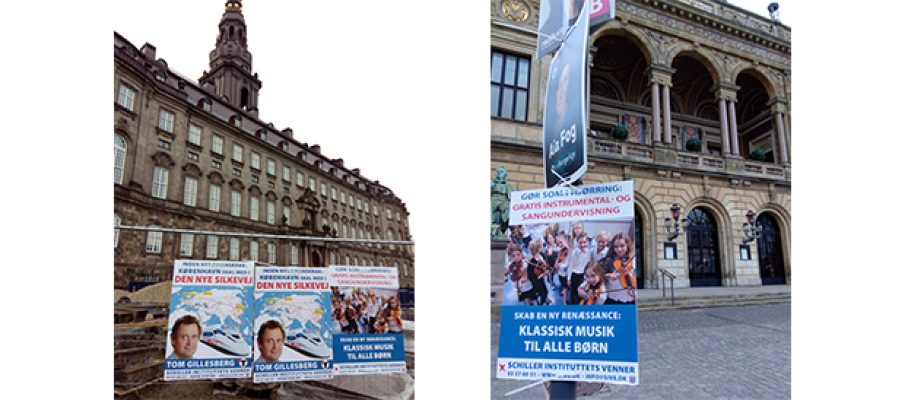
»For tolv år siden i 2005 stillede Schiller Instituttets Venner op for første gang i
København og i Århus. Dengang med et meget klart budskab: Når boblen brister …
Nyt Bretton Woods! At de stigende boligpriser, de voksende finansielle bobler meget
snart ville kollapse. I 2007 stillede jeg op til folketingsvalget med mit slogan: Efter
finanskrakket: Magnettog over Kattegat. Og advarede om, at, nu var det brag
forestående.
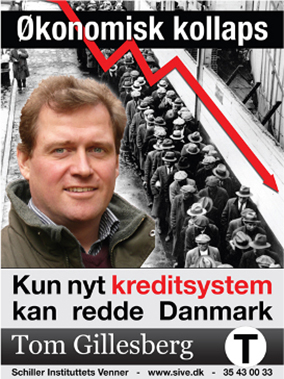
I dag står vi der igen. Mens økonomien buldrer derudad, man bygger nye boliger til
højre og venstre her i København, så er det, der er i gang internationalt, det næste,
store, finansielle sammenbrud, med den meget store forskel i forhold til 2008, at
denne gang, så kan man ikke bare sænke renterne og trykke utrolige mængder penge
og smide ud i de finansielle markeder. Den her gang, så SKAL der findes en løsning,
og den løsning skal vi forberede, allerede inden det finansielle sammenbrud sker.
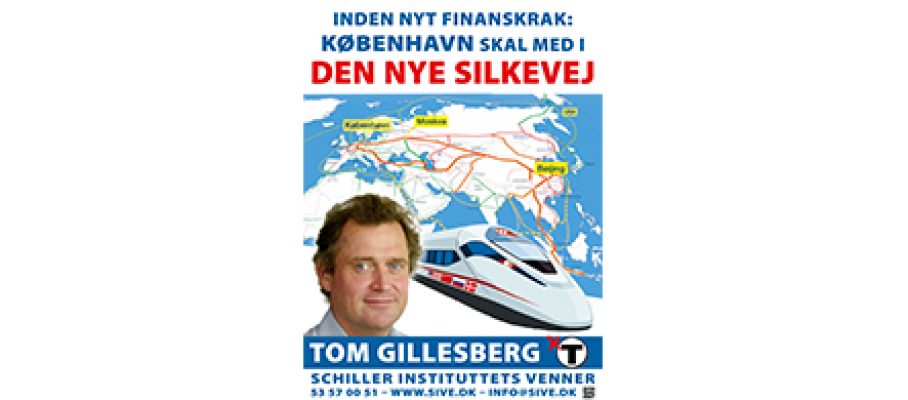
Derfor stiller vi op igen, og derfor stiller vi op denne gang med en løsning på den
krise, vi står overfor. Vi stiller op med et slogan om, at, nu skal København, ligesom
resten af Danmark, ligesom resten af Europa og USA, med i den Nye Silkevej. Vi
skal samarbejde med Kina i den form for økonomisk udvikling, som de, med stor
succes, har trukket 700 mio. kinesere ud af fattigdom med, og som man nu er i gang
med at udbrede til resten af verden, med bygning af jernbaner,
højhastighedsjernbaner, havne, kraftværker, skoler, uddannelsesinstitutioner,
hospitaler osv.
Det skal vi også i gang med. Og derfor skal vi allerede nu her i Danmark forberede os
på den tsunami, der er på vej, når dette finansielle brag bliver udløst. Vi skal sørge
for, at vi er klar med LaRouches Fire Love i en dansk version; dvs., en løsning på,
For det første: En Glass/Steagall-bankopdeling, således, at vi kan tage
finansspekulationen ud af bankaktiviteterne;
Punkt nummer to: Vi skal sørge for, at vi er klar med statslige kreditter til
infrastrukturopbygning, til store infrastrukturprojekter, som i modsætning til den
boble, vi har nu med bygning af boliger, er noget, som på lang sigt øger værdien,
produktiviteten af økonomien som helhed, i stedet for at skabe bobler.
Så skal vi også i gang med en satsning på de mest moderne teknologier, og det vil
sige højhastighedstog; det vil sige magnettog; det vil sige, at vi skal sørge for at satse
på, at Danmark er en ledende rumfartsnation; dvs., at vi skal sørge for, at vi også er
med, ikke bare i udbygningen af kernekraft, men også fusionskraft.
Det her er noget, som vi alle sammen skal kæmpe for, hvis det skal realiseres, og
derfor, så må folk ind i kampen. Derfor er det, vi vælger at stille op til kommunal- og
regionalvalg netop nu med dette program og bruge det som en platform til at kunne få
Danmark med i det nye paradigme, som netop nu er ved at erobre verden.
Forskellen mellem det, man gjorde i Europa og USA i 2008, og i Kina i 2008, står i
dag lysende klart. Kina ejede dengang ingen højhastighedstog; de har i dag 25.000
km højhastighedstog; mere end resten af verden tilsammen, og de vil fordoble det i
løbet af de kommende år. Kina løftede folk ud af fattigdom; Kina har som mål, at den
sidste fattige kineser skal være væk i 2020. Man investerede i økonomien på lang sigt
og er dermed ved at blive den ledende økonomi i verden.
I Europa; i USA – så sænkede man renten, så pumpede man enorme mængder penge
ud til finansspekulation, men opbyggede ikke den fysiske økonomi, og alle de
problemer, der var i 2008, er her derfor stadig i dag.
Schiller Instituttets Venner ønsker også at sætte en anden, meget vigtig sag på
dagsordenen. Vi skal gøre her i København og de andre byer, ligesom man har gjort i
Hjørring: Vi skal sørge for, at alle børn får tilbudt gratis instrumentalundervisning,
gratis sangundervisning. Det er vigtigt, for, gennem at spille klassisk musik, får man
ikke blot trænet sine kognitive færdigheder og sin kreativitet, men man har også
samtidig et medie, hvor man kan være social sammen med sine kammerater på det
højeste niveau. Har man tilgang til klassisk musik fra en tidlig alder, jamen, så træner
man sin forestillingsevne; så træner man sin kreativitet. Så kan man have et langt og
rigt liv, hvor musik selvfølgelig vil være en del af det; men man har også et langt og
rigt liv, hvor man er langt mere kreativ; hvor man viljemæssigt er i stand til at skabe
nye gennembrud, det være sig inden for videnskab, inden for kunst, inden for
dagligdagen, og derigennem sørge for, at vi her i Danmark for alvor vil være i stand
til at bidrage det maksimale, vi kan, ikke bare til vores egen udvikling, men også til
hele verdens udvikling.
Men det er afgørende, at det er noget, alle skal have del i, og derfor skal det være
gratis. I Hjørring har man gjort det, og det har vist sig, når man begyndte at gøre det,
så kunne det faktisk godt lade sig gøre; det kostede ikke fantasillioner, det er muligt:
Kan man gøre det i Hjørring, så kan man også gøre det her.
Vi stiller op til kommunalvalget her i København, i Brøndby, i Århus og i Randers.
Vi stiller også op til Regionsvalget i Region Hovedstaden og i Region Midtjylland.
Bliv en del af kampagnen! Gå ud og sørg for, at folk stemmer på os. Men bliv også
en del af kampagnen under valget og efter valget, for at sikre, at Danmark bliver en
del af det nye paradigme, som kommer til at skabe den største renæssance, vi
nogensinde vil have set i menneskehedens historie.«
Schiller Instituttets Venners kandidater til kommunalvalget:
Københavns Kommune, Liste T:
Tom Gillesberg
Michelle Rasmussen
Feride Istogu Gillesberg
Lissie Brobjerg
Hans Frederik Brobjerg
Brøndby Kommune, Liste T:
Christian B. Olesen
Århus Kommune, Liste L:
Hans Schultz
Randers Kommune:
Poul Gundersen
Schiller Instituttets Venners kandidater til regionsvalget:
Region Hovedstaden:
Tom Gillesberg
Michelle Rasmussen
Feride Istogu Gillesberg
Lissie Brobjerg
Hans Frederik Brobjerg
Christian B. Olesen
Region Midtjylland:
Hans Schultz
Poul Gundersen
Kontakt Schiller Instituttets Venner:
Tlf. 53 57 00 51
Tlf. 35 43 00 33
info@sive.dk
www.sive.dk







:max_bytes(150000):strip_icc():format(webp)/pet-resolutions-for-2023-2-JD940-321103a6472d4e1aad05238427f12d1f.jpg)













nov 4 2017
Schiller Instituttets Politisk Orientering ved Tom Gillesberg
Den 2. november 2017
[embedyt] https://www.youtube.com/watch?v=3ZCmvaSw8TA[/embedyt]